Xiaoyun Zeng
I 🌴 LA
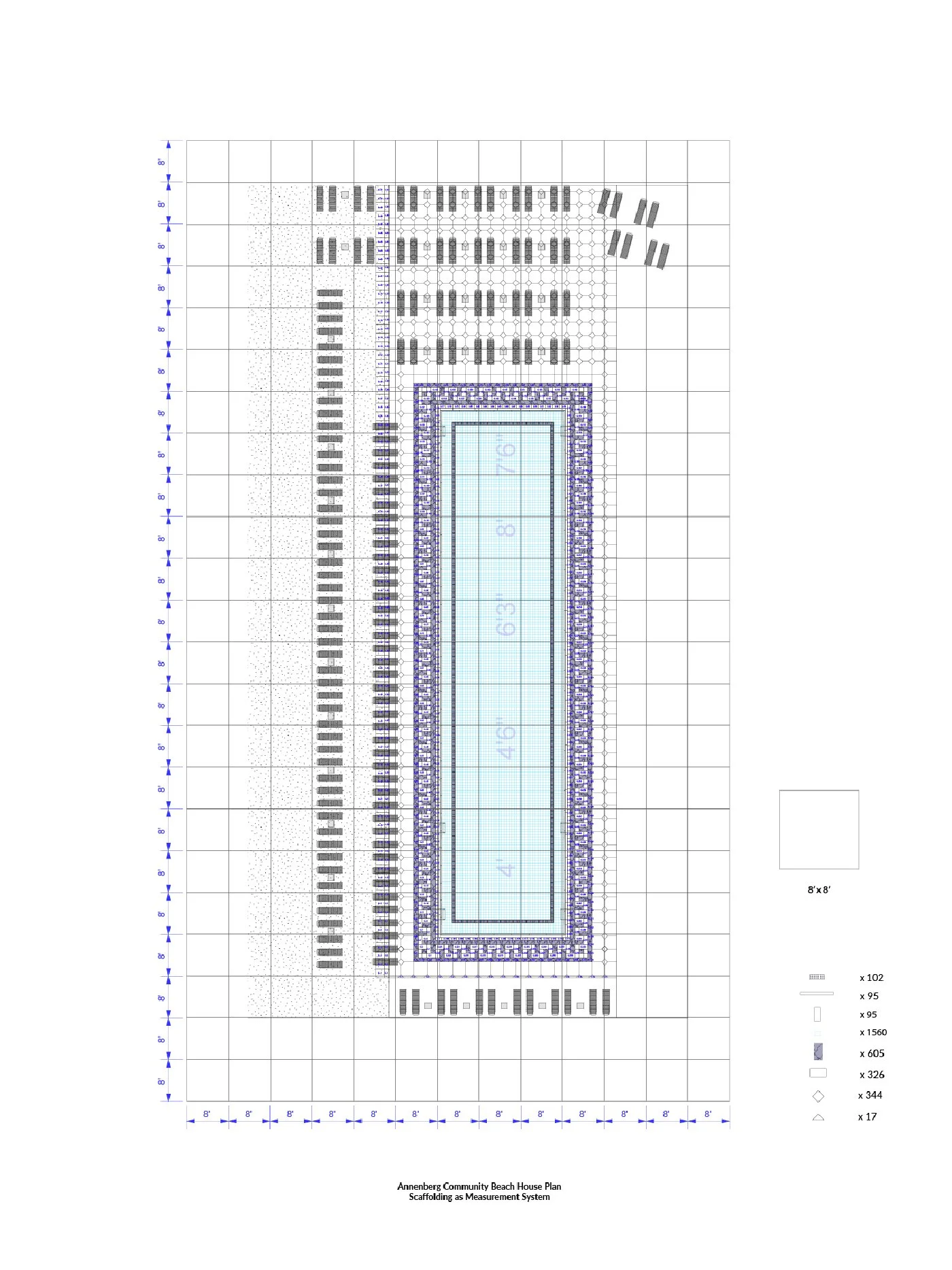
Scaffolding exists in a fascinating duality. It performs precise roles in measurement, structural support, and spatial documentation, while also serving as a flexible framework that shapes urban life. It guides movement, safeguards buildings, enables repairs, and adapts to shifting needs. Designed for temporary use, it often outlasts the architecture it supports. Historically, it has enabled extraordinary feats such as raising the Vatican obelisk and constructing St. Peter’s Basilica, drawing on techniques from shipbuilding and military engineering. Free from the constraints of permanence, it becomes a testing ground for structural innovation, the development of reusable systems, and resource-efficient construction.
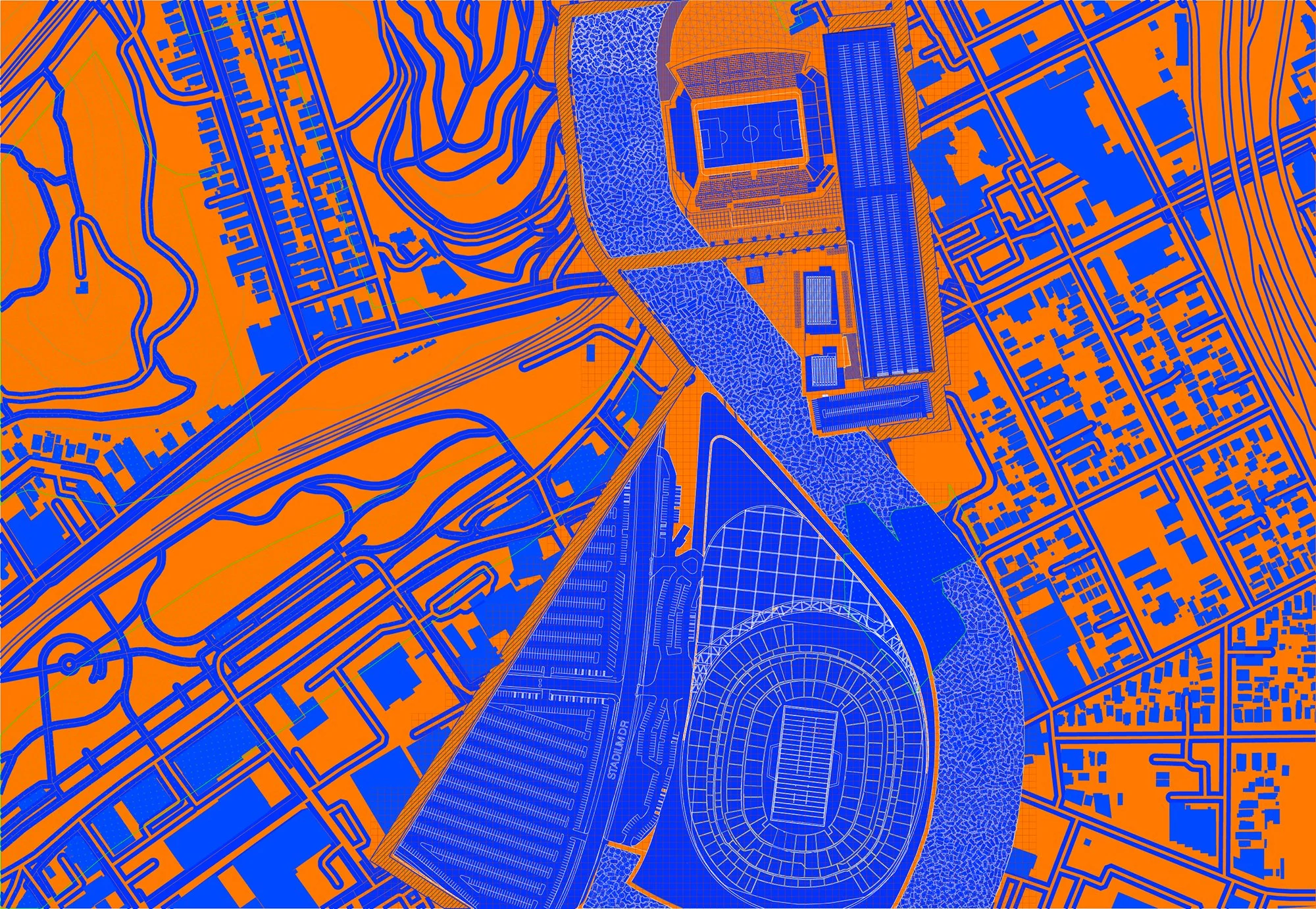
The 2028 Los Angeles Olympics will be dispersed across the city, linked more through a shared visual identity than by spatial proximity. Rather than accept this fragmentation, the project uses scaffolding to measure, document, and relocate each event’s spatial footprint onto a single site (LA river). The river’s linear path, central location, and overlooked civic potential make it both a natural connector and a stage for a unified Olympic landscape. For this project, scaffolding is the environment, serving as building, infrastructure, stages, and public activities.
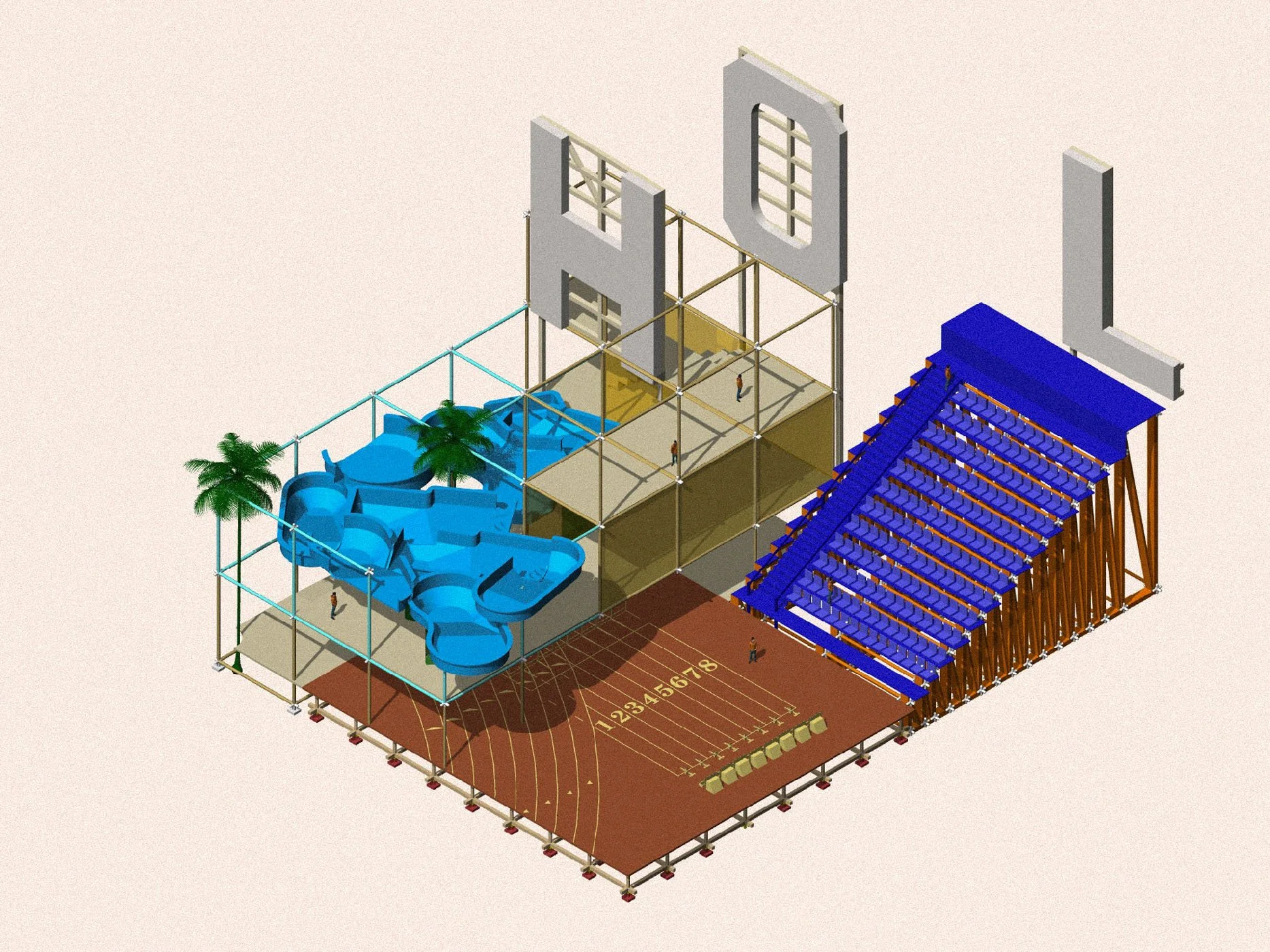
Scaffolding acts both as structure and method. It carries entire venues as well as fragments of Los Angeles: stadium seating, palm trees, swimming pools, billboards, and even the Hollywood sign, chosen for their iconic elements of Los Angeles and their ability to trigger collective memory. These elements are reorganized into a layered setting where competition, gathering, and observation take place side by side.
By adapting to context, it creates shared spaces: ramps, shaded courts, walkways, and balconies. Some parts are enclosed, others open. Some are borrowed from existing structures, others assembled anew. The project tests how a temporary, modular system can bring cohesion to a fragmented city.